Thursday, April 16, 2015

Dennett on Consciousness II – And then What Happens?

In Part I I described the introduction of philosopher Dan Dennett to the University of Waterloo for Brain Day, an annual event featuring a panel of speakers with specialty areas in the cognitive sciences. I then began to summarize Prof. Dennett’s talk, introducing the controversial concept of “philosophical zombies” and Dennett’s nonplussed reaction to them. I finished by describing an afterimage effect that seemed to have implications for the way we habitually think about consciousness. In this post, I’ll follow up with said implications and summarize the remainder of the talk – including what Dennett claims to have added to his approach with a small part at the end. Keep in mind that I’m not quite an expert on this stuff, but I’ll do my best to make the relevant points clear and explain why they’re significant.

Gazing at the discoloured American flag for any length of time caused a properly coloured afterimage to appear on the following blank slide. Dennett’s question – where is the red stripe? – seemed to provoke the answer “in our minds!” but he clearly found this answer dissatisfying. It became immediately obvious to me and everyone else in the room that the red stripe was not in the world itself, since it faded away over time and couldn’t be produced without proper preparation. It was equally clear that if the red stripe was only in our minds that it no longer existed strictly as a red stripe. This is my best guess for what Dennett intended to convey with this exercise, because it acted as a good segue to his next example. It also brought to light his immediate dismissal of “objects of consciousness,” since he never entertained the possibility that the red stripe existed in our consciousness (or experience, or qualia). (I’ll come back to correct this assumption if the video footage reveals something that I’ve missed.)

Sunday, April 12, 2015

Dennett on Consciousness I - The Hard Problem

I couldn’t have imagined when I woke up this morning that in a few hours I’d be standing face-to-face with Dan Dennett, but a particularly observant girlfriend and some quick travel arrangements procured for me that lucky opportunity. Dennett gave an hour-long talk at the Centre for Theoretical Neuroscience (CTN) at the University of Waterloo, where I was seated happily in the centre of the audience. The title of the talk was “The Hard Problem of Consciousness: What Happens Next?” and it offered a very concise and informative snapshot of Dennett’s ideas about consciousness with a small new addition. I was vaguely familiar with Dennett’s position from reading his tangential book on free will, Freedom Evolves and sifting through his newer Intuition Pumps, but it’s always nice to hear ideas from the thinkers themselves, and even more pleasant in a public forum of curious non-experts.

Like every philosophical problem that’s existed since antiquity, the literature on consciousness is enormous and intimidating. I’ve been aware (in whatever sense you like!) of the basic philosophy of mind problems for almost a year and I can’t say I’ve made super meaningful progress on any of them. Are we made of two kinds of things, or just one? If one, why do I feel like a “self” independent from my body? If two, how do they interact? The PEL podcast on the subject is a great introductory resource and it features a range of positions with fundamental disagreements even among the hosts. Another helpful video is hosted on YouTube by the CTN and features a talk given last year by Owen Flanagan, esteemed naturalist and author of The Bodhisattva's Brain: Buddhism Naturalized. Interestingly, other famous philosophers with whom I agree about one or two things seem to hold diametrically opposed positions on this issue (Nagel vs. Dennett, for example), so I’m hoping that today’s experience and a few accompanying blog posts can help clear things up for me.

Wednesday, May 15, 2013

Hello, and Let’s Get Started!

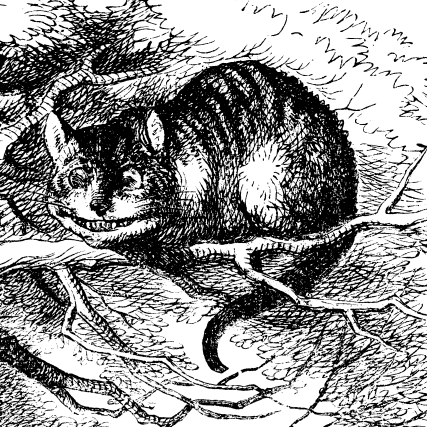
File:Cheshire Cat Tenniel.png
'Would you tell me, please, which way I ought to go from here?'
'That depends a good deal on where you want to get to,' said the Cat.
'I don't much care where —' said Alice.
'Then it doesn't matter which way you go,' said the Cat.

At first glance, it would seem that the infamous Cheshire Cat of Lewis Carroll’s Alice’s Adventures in Wonderland has produced an excellent bit of wisdom: if you don’t know where you’re going, then it doesn’t matter how you go about getting there. My immediate objection to this conversation concerns the habit that we all have of speaking in extreme, black-and-white terms. I highly doubt that Alice has no desire to get to any particular place; in fact I’m sure if she reflected upon the question she would be able to enumerate a variety of different places that she might like to visit. I believe it far more likely that Alice has some idea of where she wants to go, and so perhaps we can adjust the Cat’s response to say that if you have someplace you sort-of-maybe think you’d like to go, then the direction you choose to travel matters at least a little bit. And that’s a perfect place to start from with this blog.

Tuesday, May 14, 2013

Stay tuned! First post coming soon

Welcome to Of Ravens and Writing Desks, a blog where I intend to publicize my private thoughts in order to provoke discussions of ideas, values, facts, and fictions.

Our first post is coming right up, so come back soon! :)